


Arrow Dash Cash
Kashif Iqbal
I spent my time with Arrow Dash Cash looking at one idea above everything else: arranging moving arrows so each one has a clear route. That sounds simple, but it creates a surprisingly focused casual puzzle. The game is not asking me to memorize a long rulebook or learn a complicated control system. Instead, it makes me pause, read the board, and decide which arrow should move first.
That central capability gives the game its identity. Arrows fly in their pointing direction, and a blocked route prevents the move from working as intended. My task is to find an order that opens the board instead of making the remaining pieces harder to handle. In practice, this turns a small visual puzzle into a test of planning, patience, and quick recognition.
Developed by Kashif Iqbal, this free casual game is aimed at a broad audience and carries an Everyone age rating. It is available for Android devices running at least version 7.1, while the current release is identified as 202600701-1723. The game has passed the 100K+ install mark, which suggests that its straightforward format has found an audience without needing the complexity of a large action game.
Reading the board before making a move
The main capability is order, not speed
The most important thing I learned is that Arrow Dash Cash is less about tapping quickly and more about understanding dependencies. One arrow may appear ready, but moving it first can leave another arrow trapped behind it. A different piece may need to go before either of them, even when its direction makes it look less urgent.
This is where the game becomes more interesting than a basic tap-to-clear activity. Every arrow gives me two questions to answer: where will it travel, and what will its movement reveal or obstruct? I found myself scanning for open lanes first, then checking whether a seemingly safe move would interfere with the next one.
Related News






The useful skill is learning to treat every arrow as part of a sequence rather than as an isolated target. That small change in thinking makes the puzzles feel deliberate. It also means that a failed attempt can be informative. Instead of simply blaming a bad tap, I can identify the point where my order stopped working.
How the direction rule changes the experience
The directional movement gives each board a readable logic. An arrow is not free to travel wherever I want, so the board itself becomes the problem. I need to notice which paths are open, which are blocked, and which move might create the space required for a later one.
This makes the game suitable for short sessions because the basic interaction is easy to understand almost immediately. I do not need to spend a long time learning controls. The challenge comes from applying the rule correctly, not from remembering button combinations or managing a large collection of systems.
Gallery
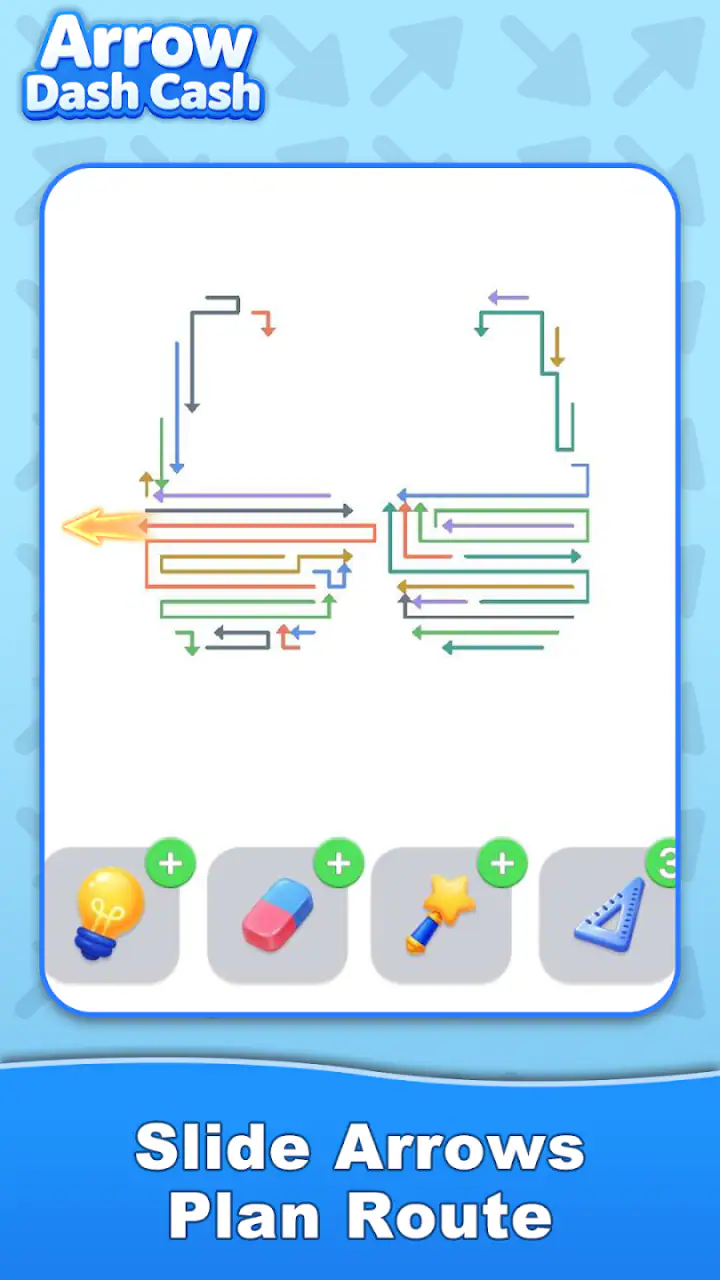
At the same time, the simplicity can expose the limits of the format. If I am looking for character progression, a story, or a deep strategy campaign, this is not the right kind of game. Its appeal depends on whether I enjoy solving compact visual problems one after another. The arrow rule is the content, not merely a feature added to something larger.
My practical method for solving a crowded board
I had better results when I stopped trying to solve the entire board in one glance. First, I looked for arrows with an obviously unobstructed route. Then I checked the space that would remain after that move. This second check mattered because a move can be correct in isolation but unhelpful for the next stage.
A useful habit is to identify the arrows that seem dependent on others. If one piece is directly in the way of another, I ask whether moving it will actually clear the route or simply expose a second blockage. That distinction prevents a common mistake: choosing the first visible opening without considering what follows.
I also found it helpful to pause after each successful move. The temptation is to continue immediately when the board appears to be clearing, but a newly opened lane can change the best order. Taking a brief look after every move reduces careless taps and keeps the puzzle readable.
For players using a smaller phone, this slower approach is especially useful. A compact screen can make several arrows look close together, and quick tapping may select the wrong one. Treating each move as a separate decision is more reliable than trying to rush through a pattern.
Why this works well in ordinary daily breaks
The best everyday use case is a short waiting period: sitting on public transport, taking a break between tasks, or relaxing before bed. I can begin with the visual problem immediately, make progress in a small amount of time, and stop without needing to remember a complicated storyline or a long-term build.
Imagine having a few minutes before an appointment. A fast arcade game might demand constant attention, while a larger puzzle game may take too much time to settle into. Arrow Dash Cash sits between those extremes. It gives me something to think about, but its main rule is simple enough to understand when my attention is limited.
It also suits people who enjoy puzzles but do not want word clues, trivia, or number grids. The challenge is spatial and sequential. I am reading directions and paths rather than interpreting a theme or calculating a large set of values. That makes the experience feel direct and visual.
However, I would not recommend it as a background game while watching a show or listening closely to a conversation. Even though the controls are uncomplicated, the important part is noticing the order. Dividing attention can lead to a poor move, especially when several arrows appear to have similar options.
Three habits that make the puzzles less frustrating
My first tip is to look for the board’s exit logic before choosing a starting arrow. The arrow that seems easiest to move is not always the best opening. I get more reliable results by checking which paths must remain available for later pieces.
My second tip is to use mistakes as a map of the puzzle. When a sequence fails, I mentally return to the last move that changed the board significantly. That usually tells me whether I started with the wrong arrow or whether I missed a dependency earlier. This is more productive than restarting with the same instinctive order.
My third tip is to avoid speed as a goal. The game’s strongest quality is the small satisfaction of finding the correct sequence, so rushing works against its design. A careful player may finish a board more consistently than someone who taps every apparently open arrow as soon as it appears.
These habits are not separate power-ups or hidden systems; they are ways of getting more from the game’s one verified capability. They matter because the directional rule rewards observation. The better I read the board, the less the experience feels like trial and error.
Where the format compares with other casual choices
Compared with match-style casual games, this one asks for less pattern matching and more ordering. I am not mainly searching for identical colors or building a chain. The question is whether one arrow should move before another, which gives the experience a more logical and spatial character.
Compared with endless runners, it is much calmer. There is no need to react continuously to an approaching obstacle. I can stop and inspect the board, which makes it a better choice for relaxed concentration. On the other hand, anyone who wants constant motion or a steady stream of reflex challenges may find it too quiet.
Compared with traditional grid puzzles, the arrow movement provides a more immediate visual goal. I can see the intended direction directly on the pieces. That lowers the entry barrier, although it does not remove the need to plan. The game is easier to understand than many formal logic puzzles, but the boards can still punish an impulsive order.
This comparison also explains why the game may appeal to a particular type of player. It is a good middle ground for someone who wants more thought than a simple matching game but less commitment than a complex strategy title. If I wanted a campaign with extensive progression or a strong narrative, I would choose something else.
The tradeoff between clarity and depth
The clean directional concept is both the game’s strength and its main limitation. Because the rule is easy to grasp, I can begin playing without friction. But because the experience is centered so tightly on that rule, players who need variety may eventually want more kinds of challenges.
There is also a difference between genuine difficulty and visual hesitation. Some boards may feel challenging because the correct order is not immediately obvious. Other moments may feel slower simply because I am checking several possible paths that look similar. That is not necessarily a flaw, but it means the game rewards a patient mindset more than an impatient one.
The free price makes experimenting easy. I can try it without treating the download as a major commitment, and the Everyone rating makes it suitable for a wide range of players. Still, “free” does not automatically mean it will suit everyone’s taste. A player who wants social competition, elaborate customization, or a large sense of progression should look toward another casual category.
Device compatibility is reasonably broad because the game supports Android 7.1 and later. That makes it accessible on older compatible phones, although the practical experience will still depend on screen size and responsiveness. On a small display, careful selection becomes more important, while a larger screen can make the arrow relationships easier to inspect.
Who will gain the most from playing
I think the strongest audience is made up of players who enjoy compact logic tasks and like improving their first instinct. The game gives those players a clear loop: inspect, choose, observe the result, and adjust. It is especially appealing if you prefer solving a problem at your own pace rather than competing against a timer or another person.
It can also work well for families because the central interaction is easy to explain. The Everyone rating supports that broad accessibility, and the visual nature of the puzzles means a younger or less experienced player can understand the goal without reading a long tutorial. Adults who enjoy casual brain teasers may appreciate the same simplicity for a different reason: it gets to the puzzle quickly.
I would suggest skipping it if your ideal casual game is built around collecting, decorating, storytelling, or constant rewards. Arrow Dash Cash does not need those elements to make its point, but that also means they are not the reason to install it. Its value comes from the satisfaction of discovering a workable sequence.
The game is also a weaker fit for someone who becomes frustrated by restarting after a mistaken order. Since the board depends on sequence, an early error can make the remaining moves awkward. Players who prefer forgiving systems may enjoy a match game or a relaxed simulation more.
What to expect before installing
The store short description calls it “Arrow Dash Cash,” while the full experience is best understood as a casual arrow-order puzzle. The free download and broad age rating make it an easy title to test, especially if you already enjoy short, self-contained challenges. I would approach it with the expectation of focused board reading rather than fast action.
The developer is Kashif Iqbal, and the current version is 202600701-1723. Those details are useful when checking that the version shown on your device matches the current release information, particularly if you are troubleshooting compatibility on an older Android phone.
My recommendation is straightforward: try it when you want a quiet puzzle that turns direction into a sequence problem. Give each board a moment before tapping, and judge it by whether that planning loop feels satisfying to you. If it does, the game offers a clean way to fill short breaks. If you need broader variety, deeper progression, or more energetic play, another casual title will probably be a better use of your time.
After playing it, I came away appreciating how much tension can come from a simple arrow and a blocked path. Arrow Dash Cash works best when you treat every move as part of the solution, not just as a tap to clear space. That focused design will not appeal to everyone, but for the right player it makes an ordinary break feel like a small, manageable logic challenge.
FAQs for Arrow Dash Cash
What is Arrow Dash Cash, and how does the game work?
Arrow Dash Cash is a casual arcade-style game built around quick reactions, aiming, and navigating arrow-based challenges. During a session, you typically control or guide arrows through obstacles, collect rewards, and try to achieve a higher score. The controls are designed to be easy to learn, although later stages may require more precise timing and repeated attempts.
Is Arrow Dash Cash free to download and play?
Arrow Dash Cash can generally be downloaded without an upfront purchase, but the exact monetization system may include advertisements, optional in-app purchases, or reward-related features. Before installing, check the current Google Play Store or App Store listing for pricing details, supported payment methods, and any subscription information. Never assume that every advertised reward is guaranteed or immediately withdrawable.
Can players really earn money or cash rewards with Arrow Dash Cash?
The name suggests a cash or rewards element, but users should approach such claims carefully. Any available points, coins, gift cards, or cash-out options may depend on eligibility, minimum thresholds, location, verification, and changing promotional rules. Read the app’s official terms, privacy policy, and withdrawal conditions before spending significant time, watching advertisements, or providing personal information.
Does Arrow Dash Cash require an internet connection?
Some parts of Arrow Dash Cash may work offline, especially basic gameplay, but an internet connection can be necessary for advertisements, account synchronization, leaderboard updates, reward tracking, purchases, or cash-out requests. Availability may also vary according to the device and app version. If you plan to use reward features, a stable connection is usually recommended to prevent progress or transaction data from failing to update.
Is Arrow Dash Cash safe to install and what permissions might it request?
Install Arrow Dash Cash only from a reputable official store and verify the developer name, recent reviews, update history, and requested permissions before downloading. A simple arcade game should not normally need access to sensitive functions unrelated to gameplay. Review the privacy policy carefully, avoid entering unnecessary financial details, and uninstall the app if it requests suspicious permissions or displays misleading payment and reward instructions.
Pros
- Quick
- simple gameplay that is easy to understand from the first round.
- Short sessions make it convenient for casual play during spare moments.
- Responsive arrow controls feel natural on touchscreen devices.
- Bright visuals and clear targets make the action easy to follow.
- Lightweight design should run smoothly on many Android and iOS devices.
Cons
- Gameplay may become repetitive after extended play sessions.
- Progress can feel slow without frequent rewards or bonuses.
- Ads may interrupt the experience
- especially after completed rounds.
- Limited depth may disappoint players looking for strategy or story.
- Requires careful timing
- which can feel frustrating on smaller screens.


